The Opportunity Blueprint: Decoding the White House Critical and Emerging Technologies (CET) List
- Jordan Clayton

- Aug 14, 2025
- 6 min read
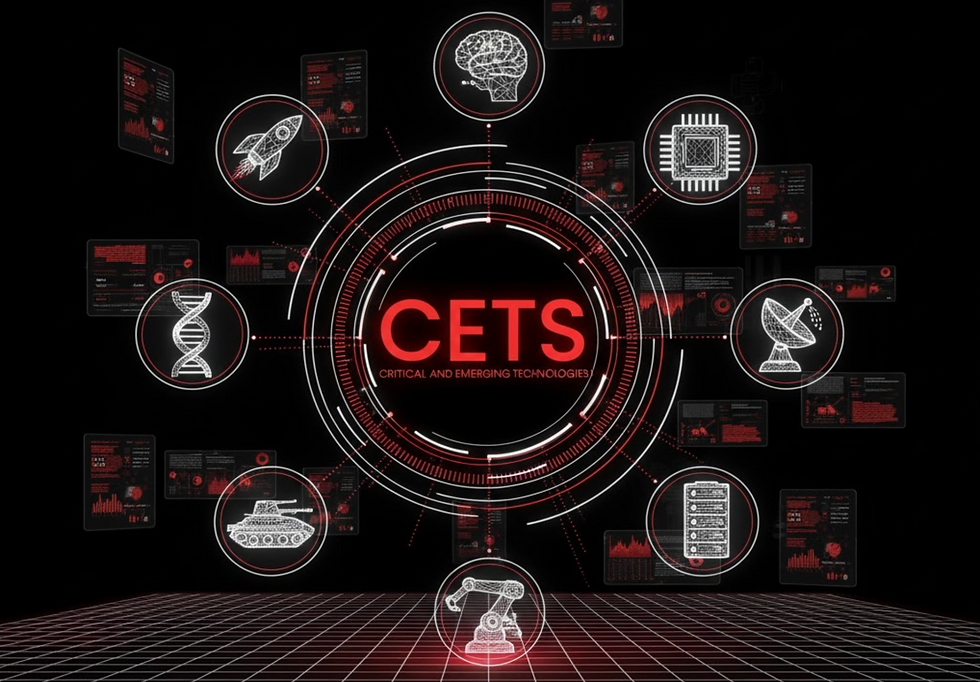
Every few years, the White House Office of Science and Technology Policy (OSTP) releases a document that typically languishes in the inboxes of policy wonks, barely registering in Silicon Valley boardrooms. To the uninitiated founder focused on product-market fit, this list looks like just another government report - dense, bureaucratic, and disconnected from the visceral reality of building a product.
This is a critical misread.
The Critical and Emerging Technologies (CET) list is not a "report." It is the architect's blueprint for the future fight. It is the White House explicitly telling the Department of Defense (DoD), the Intelligence Community (IC), and the entire federal R&D apparatus: "These are the technologies that will determine whether America leads or follows. Focus your trillions here".
For serious defense technology companies, the CET list is not optional reading; it is the foundation of your strategic alignment. If your technology does not map to one of these areas, you are pitching a solution to a problem the government has not prioritized. Conversely, aligning with a CET validates your existence in the eyes of the budget process.
At DualSight, our mission is to align emerging capability with real mission need. The CET list is the highest-level definition of that need. Here is the full blueprint, decoded for the operator.
The Strategic Imperative: Why This List Matters
The CET designation is a market signal that transcends any single Program Office. It carries three distinct strategic advantages:
Validated National Priority: These are not just DoD interests; they are whole-of-government priorities critical for both national security and economic leadership.
The Funding Magnet: Billions in R&D funding (DoD, DoE, NSF) and strategic capital (like the CHIPS Act or the Office of Strategic Capital’s mandate) are deliberately channeled toward these areas. It is the "color of money" guide for the next decade.
Justification Power: Aligning your solution with a CET gives your internal DoD champion the high-level policy justification needed to advocate for your program within the complex PPBE budget process.
Decoding the Blueprint: The 18 Critical Areas
The CET list is broken down into 18 specific technology areas. We have analyzed each to identify the underlying mission problem and the opportunity for defense innovators.
1. Advanced Computing
The Mission Problem: The speed of decision-making. The DoD needs to process vast sensor data faster than adversaries, run complex simulations for nuclear stewardship, and enable AI at the tactical edge where bandwidth is non-existent.
The Opportunity: This area pushes computation beyond current limits. Opportunities abound for novel chip architectures, rugged edge devices, AI accelerators, and high-performance computing (HPC) stacks. Founders should emphasize computational resilience in constrained environments.
2. Advanced Engineering Materials
The Mission Problem: Survivability and performance. Platforms need to be lighter to fly further, stronger to survive hits, and heat-resistant to endure hypersonic flight.
The Opportunity: Innovations in composites, metamaterials, and nanomaterials. If you have a material that reduces weight (SWaP-C) or manages thermal loads for directed energy weapons, you are solving a Tier 1 problem.
3. Advanced Gas Turbine Engine Technologies
The Mission Problem: Power projection. The strategic imperative is to increase the range and speed of aircraft and missiles to operate in the vast distances of the Pacific theater (INDOPACOM).
The Opportunity: Next-generation engines delivering higher thrust and greater fuel efficiency. Opportunities lie in high-temp materials for hot sections, adaptive cycle engines, and hybrid-electric propulsion concepts.
4. Advanced Networked Sensing & Signature Management
The Mission Problem: "See without being seen." The mission demands persistent, all-domain situational awareness while surviving detection in highly contested environments.
The Opportunity: This encompasses superior sensors (RF, EO/IR, acoustic) fused into a coherent picture, alongside technologies that reduce electromagnetic footprints (stealth). If you can manipulate signatures or fuse data at the edge, you are essential.
5. Advanced Manufacturing
The Mission Problem: Logistics resilience. The current supply chain is brittle. The DoD needs to produce parts on demand at the tactical edge to keep systems fighting.
The Opportunity: Additive manufacturing (3D printing), digital twins for predictive maintenance, and secure microelectronics fabrication. The goal is to decouple readiness from long, vulnerable supply lines.
6. Artificial Intelligence (AI)
The Mission Problem: Cognitive overload. Operators are drowning in data. AI is essential to accelerate the OODA Loop (Observe, Orient, Decide, Act), predict adversary actions, and automate dangerous logistics tasks.
The Opportunity: Beyond LLMs, the DoD needs computer vision for ISR, predictive maintenance algorithms, and trusted AI that can be validated for safety in weapon systems.
7. Biotechnologies
The Mission Problem: Warfighter protection and sustainment. The need to protect soldiers from bio-threats and generate resources (fuel, medicine) in austere environments.
The Opportunity: Synthetic biology, bio-manufacturing, and human performance technologies. Solutions that offer rapid bio-threat detection or point-of-need logistics (e.g., growing cement or fuel) are highly relevant.
8. Clean Energy Generation & Storage
The Mission Problem: The "Fuel Tail." Moving fuel to the front lines is dangerous and expensive. The mission driver is reducing this logistical burden while powering energy-intensive directed energy weapons.
The Opportunity: High-density next-gen batteries, hydrogen fuel cells, and smart microgrids. The focus is on operational endurance and resilience, not just "green" mandates.
9. Data Privacy, Security, & Cybersecurity
The Mission Problem: Network trust. Protecting critical weapon systems from cyber-attack and securing the data that flows through them.
The Opportunity: Zero Trust Architecture (ZTA), post-quantum cryptography (PQC), and AI-driven threat hunting. If you can secure the "tactical cloud," you have a customer.
10. Directed Energy (DE)
The Mission Problem: Cost-effective defense. Shooting down a $1,000 drone with a $2M missile is economically unsustainable. DE offers "deep magazines" and "cost-per-shot" measured in pennies.
The Opportunity: High-power lasers and high-power microwaves (HPM). The bottleneck is typically SWaP (Size, Weight, and Power) and thermal management. Solve that, and you solve the drone swarm problem.
11. Autonomous & Uncrewed Systems
The Mission Problem: Affordable mass. The US cannot match adversaries hull-for-hull with expensive manned platforms. We need "attritable" mass that removes humans from harm's way.
The Opportunity: Collaborative autonomy (swarming), trusted human-machine teaming, and low-cost robotic platforms across air, sea, and land.
12. Human-Machine Interfaces (HMI)
The Mission Problem: Complexity management. As systems become more autonomous, the human operator needs intuitive ways to control them without being overwhelmed.
The Opportunity: AR/VR for training and maintenance, brain-computer interfaces (BCIs), and AI co-pilots. The goal is to reduce cognitive load.
13. Hypersonics
The Mission Problem: Rapid global strike. The ability to hit time-sensitive targets anywhere in the world in minutes, evading current missile defenses.
The Opportunity: Scramjet propulsion, high-temperature materials, and the specialized sensors needed to track hostile hypersonic gliders.
14. Integrated Communication & Networking
The Mission Problem: JADC2 (Joint All-Domain Command and Control). Ensuring the Army can talk to the Navy in a jammed environment.
The Opportunity: 5G/6G, resilient waveforms, mesh networking, and optical (laser) communications. The imperative is interoperability and low latency.
15. Positioning, Navigation, and Timing (PNT)
The Mission Problem: GPS dependence. GPS is vulnerable to jamming and spoofing. The force must be able to fight when the satellite signal goes dark.
The Opportunity: Alternative PNT (Alt-PNT), magnetic anomaly navigation, celestial navigation, and chip-scale atomic clocks. "Resilience" is the keyword here.
16. Quantum Information Technologies (QIST)
The Mission Problem: The future of encryption and sensing. Quantum computers threaten current encryption; quantum sensors promise unjammable navigation.
The Opportunity: Quantum sensors for PNT, quantum key distribution for secure comms, and preparing for the "Post-Quantum" cryptographic transition.
17. Semiconductors & Microelectronics
The Mission Problem: Supply chain sovereignty. The US cannot rely on contested foreign supply chains for the chips that power its weapons.
The Opportunity: Secure domestic manufacturing, advanced packaging, and "rad-hard" chips for space applications. This is heavily supported by the CHIPS Act.
18. Space Technologies
The Mission Problem: Space is a warfighting domain. We need to protect our assets and operate in a contested environment.
The Opportunity: Proliferated LEO constellations (thousands of small sats), Space Domain Awareness (SDA) sensors to track debris/threats, and on-orbit servicing.
Alignment is Execution
The CET list is not just a technical roadmap; it is a statement of strategic intent. It tells you where the nation is placing its bets for the next decade. Ignoring this list means risking the "Valley of Death" by building something the government does not value. Aligning with it provides the credibility, justification, and future-proofing required to scale.
The blueprint is public, but the execution is where winners are made. At DualSight, translating these high-level priorities into actionable capture strategies is our core mission. We help you map your capability to the CET list, craft the narrative that resonates with mission owners, and build the artifacts needed to turn alignment into funded programs.


